



Property owners in London and surrounding municipalities face a critical decision when a tree shows signs of damage, disease or structural weakness: act on instinct, or get the facts in writing. A arborist report and risk assessment is a formal, documented evaluation of a tree's health and the hazard it may pose to structures, utilities or people. We prepare these reports to support insurance claims, property transactions, neighbour disputes and many applications for tree removal permits that the City of London requires. Our ISA Certified Arborists inspect the tree on site, document defects with photographs and measurements, and deliver a professional report you can present to your insurer, a real estate lawyer or a municipal building department.
Mature trees on ravine lots, post-war subdivisions and properties with tight backyards are common across London. Ice storms and summer windstorms can weaken branches and trunks without obvious warning. A written assessment protects you by creating a clear record of the tree's condition at a specific date, and it often accelerates permit applications or insurance decisions.
Why an arborist report matters for London homeowners
The City of London may require a permit for a private tree removal, and the application is normally supported by an arborist report. Even when a permit is not mandatory, a professional assessment demonstrates due diligence to your insurer and protects you legally if a tree fails and causes damage. Neighbours sometimes dispute a removal or trimming plan; a certified arborist's report settles those disputes with objective evidence. Property buyers and their lenders often request an assessment of large or declining trees before closing a sale.
- We document the tree's species, height, diameter and overall structure using industry-standard methods.
- We identify visible defects such as cracks, cavities, lean, dead branches and signs of disease or pest damage.
- We evaluate the tree's proximity to buildings, power lines, fences and other structures to assess risk.
- We deliver a written report with photographs, a risk rating and clear recommendations for management or removal.
- We provide the report in a format accepted by municipal planning departments and insurance adjusters across the London area.
A professional report removes guesswork and gives you confidence in your decision.
Local insight: In London and Middlesex Centre, many properties have mature silver and sugar maples planted in the 1950s and 1960s. These trees are now 60 to 80 years old and often show signs of stress from soil compaction, root damage or storm injury. An arborist report quantifies the risk and guides your decision to prune, cable or remove before a failure occurs.
How we conduct an arborist assessment in the London area
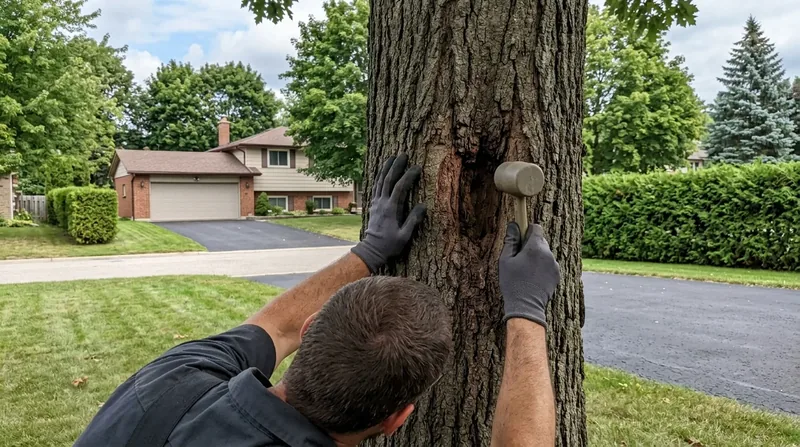
Our process combines field inspection, professional documentation and clear communication. We arrive with climbing equipment, measuring tools and a camera. We examine the tree from the ground and, when necessary, climb into the canopy to inspect branches and the trunk from close range. We record measurements, take photographs of defects and note the tree's age, species and condition relative to similar trees in your neighbourhood.
- We perform a visual structural inspection, checking the trunk, major branches and root collar for signs of damage, disease or decay.
- We assess the tree's lean, crown density and branch attachment angles to determine structural stability.
- We use a resistograph or sonic tomography tool if decay is suspected, to evaluate wood density inside the trunk.
- We document the tree's location relative to your house, garage, deck, power lines and neighbours' property.
- We rate the overall risk as low, moderate or high based on the tree's condition and the value of nearby structures or people.
- We deliver a typed report with site photos, findings and actionable recommendations within 3 to 5 business days.
The report is yours to keep and share with your insurer, a lawyer or the City of London.
Real example: A homeowner in Sunningdale noticed a large red oak leaning slightly toward the house after a spring windstorm. Our assessment found internal decay in the main stem and root damage from soil settling. We rated the tree as high risk and recommended removal. The homeowner presented our report to his insurer, who approved coverage for the removal and stump grinding. Total cost was covered under the homeowner's policy.
Assessment methods and tools we use
| Method | Description | When we use it |
|---|---|---|
| Visual inspection | Ground-level and climbing examination of trunk, branches, foliage and root collar. | Every assessment, standard for all trees. |
| Resistograph testing | A drill bit measures wood density at multiple points in the trunk to detect hidden decay. | When the tree shows external signs of cavity, hollow or soft wood. |
| Sonic tomography | Sound waves map the internal condition of the trunk, revealing decay or structural weakness. | For high-value trees or when risk rating depends on internal soundness. |
| Photographic documentation | Close-up photos of defects, cracks, branch angles and tree position relative to structures. | Every report; images are included in the written assessment. |
| Risk rating and recommendation | We classify the tree as low, moderate or high risk and suggest management options or removal. | Final step of every assessment; guides your next decision. |
Each method is chosen based on the tree's condition, age, size and proximity to structures. Our arborists hold current ISA Certified Arborist credentials and follow industry standards for risk assessment.
Regulatory context and permit support
The City of London and other municipalities in the London area may require a permit before you remove a private tree. An arborist report is the standard supporting document for a removal permit application. We prepare reports that clearly state the reason for removal (structural failure, disease, dead wood, hazard to structures) so that your application moves quickly through the review process. We do not prepare permits ourselves, but our report provides the evidence municipal staff need to approve your application. Approach distances must also be respected near private electrical service entrances; our assessment notes the clearance between the tree and any power lines on your property.
We have worked with the City of London and surrounding municipalities for over a decade. We understand what information each planning department requires and format our reports accordingly. When you contact us for an assessment, let us know if you are applying for a removal permit; we ensure the report includes all required details.
For trees near hydro lines, we assess the tree's condition and recommend whether trimming or removal is needed to maintain safe clearance from your private service entrance. We never work on the public distribution network operated by your local utility or Hydro One; our work is limited to clearance around your own home and structures.
When to order an assessment in the London area
Order an arborist report if you notice signs of decline, damage or structural concern. Spring and autumn are ideal seasons for assessment because the tree's condition is most visible after winter stress or summer storms. However, we perform assessments year-round; there is no bad time to get a professional opinion.
- After a windstorm or ice storm, if large branches are broken or the trunk is cracked or leaning.
- If the tree shows signs of disease such as cankers, discoloured foliage, sparse branching or pest damage from emerald ash borer, bark beetles or other insects.
- If you are selling your property and the buyer's lender or inspector has flagged a large or declining tree.
- If a neighbour has complained about branches overhanging their property or threatening their structures.
- If you are planning major work such as a deck or addition and need to confirm the tree's stability before construction begins.
- If you simply want a baseline assessment of a mature tree's health and longevity.
Contact us at (548) 708-7545 or visit our contact page to schedule a free estimate. We will visit your property, examine the tree and provide a quote for the assessment report. Most reports are completed within one week of the site visit.
For emergency situations such as a tree down across your roof or a large branch threatening to fall, we also offer 24/7 emergency tree removal. If the emergency requires documentation for your insurer, we can include a damage assessment in our emergency response.
Learn more about our full range of services, including tree removal, tree trimming and tree disease diagnosis, or request a free estimate today.
Prices Arborist Report & Risk Assessment in London — Indicative pricing
| Service | Price | Details |
|---|---|---|
| Standard arborist report and risk assessment | From $225 | Single tree, visual inspection, written report with photographs and recommendations |
| Assessment with resistograph or sonic testing | From $350 | Includes internal decay detection for trees with suspected hollow or compromised wood |
| Multiple trees or complex property | From $450 | Assessment of 3 or more trees, or large property with ravine lot or utility line concerns |
| Permit application support | Included | Report formatted to meet City of London and municipal requirements |
| Travel | Included | In London and the surrounding municipalities |
| Free estimate | No charge | We visit your property, assess the tree and provide a firm quote by phone within 24 hours. |
Indicative prices; free, personalized estimate within 24h at (548) 708-7545.