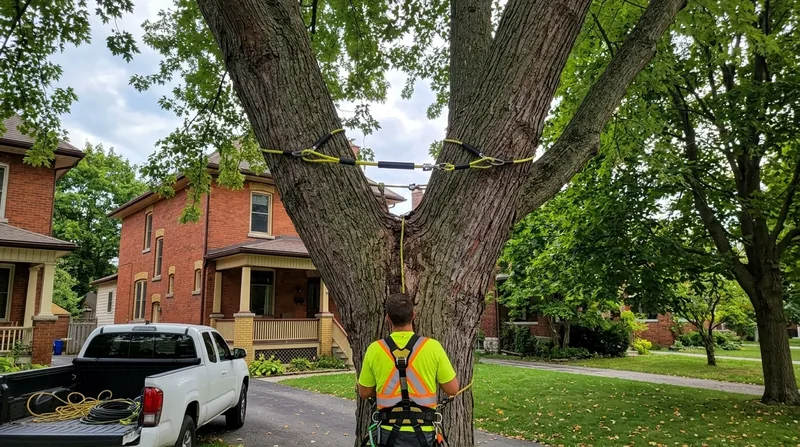




Tree cabling and bracing in London preserves mature trees with structural weakness, weak branch unions, or cracked scaffold limbs that might otherwise require removal. Forest City Tree Trimming has been installing flexible cabling and bracing systems since 2012, using ISA-approved techniques to stabilize trees across the London area and surrounding municipalities. Many properties here feature older specimens, silver and sugar maples, red and white oaks, and birches that have stood for decades. When these trees develop mechanical stress from ice storms, windstorms, or natural weight imbalance, cabling offers a proven alternative to felling. We assess each tree on site, design a custom support system, and install it safely. Request a free estimate today.
Why cabling and bracing prevents unnecessary removal
Mature trees are irreplaceable assets on any London property. An oak or maple that has grown for 50 or 60 years cannot be replicated in a decade. When a tree develops a weak crotch, a cracked limb, or leans after soil erosion on a ravine lot, removal feels inevitable. Cabling and bracing systems redirect load, reduce stress on the damaged union, and allow the tree to compartmentalize and heal. The result is a living tree that continues to provide shade, privacy, and ecological value.
- We stabilize weak branch unions without harming the tree's vascular system.
- Dynamic cabling flexes with wind, reducing shock load and promoting natural strength development.
- Bracing hardware is installed above the point of weakness to transfer load safely.
- The system can remain in place for 10 to 20 years, often indefinitely if properly maintained.
- Cabled trees often outperform their uncabled neighbours during ice storms and high winds.
Keeping a mature tree standing preserves your landscape character and protects your property's long-term value.
Local example: A 45-year-old silver maple on a Sunningdale property developed a 40-centimetre crack in a main scaffold limb after an ice storm. Removal would have cost $2,800 to $3,500 and left a bare spot. Cabling and bracing cost $1,200 and restored full structural integrity within one season.
How we install cabling and bracing in the London area
Our ISA Certified Arborists conduct a detailed structural assessment before recommending any system. We examine the tree's lean, measure the crack or weak union, and test wood integrity using a resistance drill. Every installation is tailored to the specific defect and the tree's species, size, and location. We use only industry-standard hardware, including flexible cabling rated for dynamic load, and we position all anchor points above the zone of weakness to maximize effectiveness.
- We inspect the tree and document its condition with photographs and measurements.
- We select appropriate cable gauge and material based on the load calculation.
- We install anchors into sound wood at least 30 centimetres in diameter, using threaded bolts and dynamic cable.
- We position the cable to reduce stress on the weak union without restricting natural movement.
- We provide written documentation of the system and recommend follow-up inspection every two to three years.
The installation typically takes two to four hours, depending on tree height, access, and the number of weak points requiring support. We clean up all debris and leave your property ready for use immediately after completion.
Real scenario: A red oak in Thames Centre with a 35-degree lean and a V-shaped crotch received three-point cabling and a single brace rod. Total time on site was three hours. The tree has remained stable through two subsequent windstorms and continues to grow normally.
Cabling systems and bracing methods compared
| System Type | Application | Typical Lifespan |
|---|---|---|
| Dynamic cabling | Weak branch unions, co-dominant stems, horizontal cracks in main limbs | 10 to 20 years with inspection |
| Rigid bracing | Vertical or near-vertical cracks, severe lean, major structural damage | 15 to 25 years, often indefinite |
| Combination cabling and bracing | Multiple weak points, large old trees with complex structural issues | 20+ years with regular maintenance |
| Temporary support | Young trees recovering from storm damage or transplant shock | 2 to 5 years, then removal |
Each system is reversible and does not harm the tree's long-term health or growth. Our arborists choose the method that balances structural need with the tree's natural biology.
Regulatory and safety considerations
When a tree stands near your private electrical service entrance (the wire running from the utility pole to your home), we maintain safe approach distances and never work on the public distribution network operated by Hydro One or your local utility. Cabling and bracing do not require a municipal permit in most London neighbourhoods, but if your property is in a heritage zone or subject to specific bylaws, we advise you to check with the City of London before work begins. We carry full liability insurance and provide certificates of coverage on request. Our crew follows all ISA standards for rigging, fall protection, and equipment safety.
If your tree has been damaged by storm or disease and you are considering whether to cable or remove it, an arborist report and risk assessment will document the tree's condition and support any decision you make or any application to the City. We complete these reports regularly and have been serving the London area since 2012.
Maintenance and long-term care
A cabled or braced tree is not set and forgotten. Regular inspection catches cable wear, wood growth around bolts, and changes in the tree's lean or crack pattern. We recommend inspection every two to three years, especially after severe weather. If cable tension needs adjustment or hardware shows corrosion, we make those repairs promptly. Many customers find that a cabled tree benefits from follow-up pruning to reduce canopy weight and further reduce stress on the weak union.
For ongoing care and monitoring, professional tree trimming and tree disease diagnosis ensure your mature specimens remain healthy and structurally sound for decades. Call us at (548) 708-7545 to schedule a free estimate or inspection.
Prices Tree Cabling & Bracing in London — Indicative pricing
| Service | Price | Details |
|---|---|---|
| Single point cabling system | From $650 | One weak union or crack, standard height under 15 metres |
| Multi-point cabling and bracing | From $1,200 | Two or more weak points, mature tree over 15 metres, complex geometry |
| Inspection and maintenance | From $250 | Annual or bi-annual check of existing systems, cable tension adjustment, hardware inspection |
| Complex or large tree installation | By free estimate | Trees over 25 metres, multiple structural issues, difficult access or ravine lots |
| Free estimate | No charge | On-site assessment, photos, written recommendation, response within 24 hours at (548) 708-7545 |
Indicative prices; free, personalized estimate within 24h at (548) 708-7545.