



Tree pruning and crown reduction in London require the precision of certified arborists who understand the local growing conditions and the structural demands placed on mature hardwoods. London's post-war subdivisions are lined with sugar maples, red oaks and beeches that have spent decades reaching toward the sky. Wind funnels between houses, ice storms load branches unevenly, and root systems compete for space in clay soil. We intervene to restore structural balance, reduce wind sail, and extend the life of these trees without carving an artificial silhouette into their canopy. Forest City Tree Trimming has managed crown work across the London area since 2012, using ISA Certified Arborists who read each tree's individual framework before making a single cut. Request your free estimate and we will assess the specific needs of your property.
Why crown reduction matters on mature London trees
A mature maple or oak in the London area carries weight that younger specimens do not. Winter ice storms deposit load unevenly across the crown, creating leverage on branch unions. Summer windstorms hit trees broadside. Soil compaction and utility work near the root zone reduce stability. Crown reduction addresses these pressures by removing or shortening branches that create mechanical stress, redistributing weight closer to the trunk, and improving air flow through the canopy. The result is a tree that resists storm damage, sheds ice and snow more effectively, and continues to thrive for decades.
- We remove dead or diseased branches that weaken the framework and harbour pests.
- We thin the crown to reduce wind resistance without opening the canopy too dramatically.
- We rebalance asymmetrical growth that places uneven stress on main limbs.
- We maintain the tree's natural form and silhouette, avoiding the topped or pollarded appearance of poor pruning.
- We cut back overhanging branches that threaten roofs, hydro lines or neighbouring property.
Structural work on the framework prevents costly failures and keeps your trees productive members of the landscape.
Local example: A 45-year-old sugar maple in Sunningdale with a split crotch and two major limbs hanging toward the house required crown reduction to remove the split section, shorten one limb by 2.5 metres, and thin the interior. The work cost from $685 and took one crew one day. Without intervention, a winter ice load would have dropped a 3-tonne branch across the roof.
How we approach structural pruning in the London area
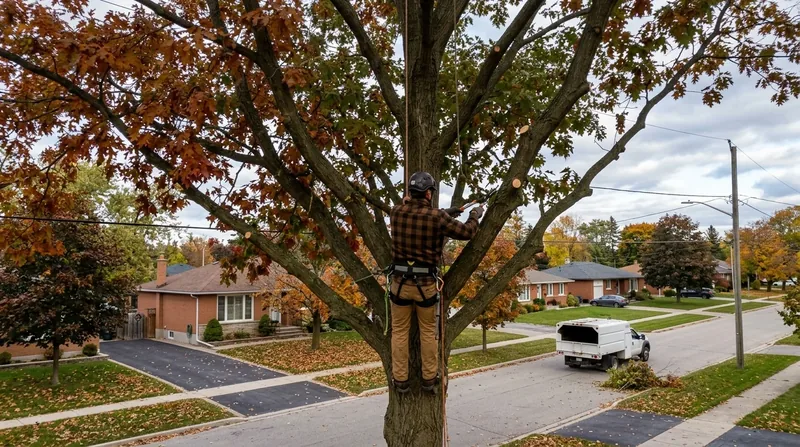
Every crown reduction begins with a walk-through assessment. We look at the tree's age, species, site conditions (ravine lot, tight backyard, proximity to structures) and the specific defects or imbalances you have noticed. We then develop a plan that removes the minimum amount of wood necessary to achieve the structural goal. Cuts are made at the branch collar, never flush to the trunk and never leaving a stub. We work from the ground up using rope and harness for safety, and we chip or remove all debris on site.
- We inspect the crown for dead, diseased, crossing or rubbing branches and mark them for removal.
- We identify primary limbs that are too long, too heavy or creating imbalance and plan proportional reductions.
- We thin interior branches to improve light penetration and air flow, reducing disease pressure.
- We prune back growth encroaching on hydro lines, respecting safe approach distances from your private service entrance.
- We lower branches or sections to the ground using ropes, never dropping them, and haul away all debris.
- We document the work with photos for your records and for any municipal permit application.
The result is a tree restored to health and mechanical stability, ready to grow another generation in your garden.
Typical project in Masonville: A 50-year-old red oak with two main limbs of unequal length and interior deadwood underwent crown thinning and selective shortening. We removed 8 to 10 percent of the crown volume, improving structure and light. Cost from $545. The tree now sheds wind and snow more effectively and will remain stable for another 20 years.
Methods we use for crown work
| Method | Description | When we use it |
|---|---|---|
| Crown thinning | Selective removal of interior branches to increase light and air flow through the canopy. | Trees with dense growth, poor light penetration, or disease pressure from humidity. |
| Crown reduction | Shortening of primary limbs to reduce height, spread or weight, maintaining natural form. | Mature trees too tall for their site, limbs overhanging structures, or unbalanced growth. |
| Crown rebalancing | Selective pruning to redistribute weight and correct asymmetrical growth patterns. | Trees with uneven limb length, codominant stems, or previous storm damage. |
| Structural removal of defective wood | Removal of dead, diseased, split or hazardous branches that weaken the framework. | Any tree with visible cracks, cavities, cankers or branches showing decline. |
| Clearance pruning | Removal or shortening of branches encroaching on roofs, power lines or neighbouring property. | Trees in close quarters, tight backyards, or with growth toward hydro lines. |
Each method is applied only where the tree's condition and your site require it. We do not over-prune, and we do not remove more than 25 percent of the crown in a single year unless the tree is in immediate danger.
Timing and seasonal considerations
Dormancy (late fall to late winter) is the optimal window for structural pruning and crown reduction. The tree is not actively growing, wounds close slowly, and there is no sap flow to attract insects or disease. London's freeze-thaw cycles and winter ice storms make autumn and early spring the ideal times to assess structural damage and plan reductions. We avoid pruning during active growth in spring and summer, when cuts bleed sap and the tree diverts energy to wound closure rather than branch development. Emergency pruning after storms can happen any time, and we respond 24/7 to dangerous limbs or hazardous conditions.
If your tree is showing signs of stress, decay or imbalance now, schedule your free estimate and we will advise you on the best timing for the work. Many homeowners in Stoneybrook and Thames Centre have their trees assessed in autumn, then pruned in January or February when the ground is frozen and crew access is easiest.
Permits and regulations in the London area
The City of London may require a permit for a private tree removal, and a permit application is normally supported by an arborist report documenting the tree's condition and the reasons for the work. Rules and thresholds differ from one municipality to the next across the London area, including Middlesex Centre, Strathroy-Caradoc and Thames Centre. Crown reduction is often a less invasive alternative to full removal and may not require a permit depending on the tree's size and species. We are familiar with local bylaws and will advise you on whether your project requires municipal approval. If a permit is needed, we can prepare or support the arborist report as part of our assessment.
We also respect approach distances near your private electrical service entrance (the wire from the pole to your house) and never work on the public distribution network operated by your local utility or Hydro One. Clearance around hydro lines is always performed within safe working distances and in coordination with your utility if required.
We are fully insured and carry current liability coverage for all work in the London area. Learn more about arborist reports and risk assessment or contact us to discuss your specific situation.
Why choose Forest City Tree Trimming for your crown work
We have been trimming and pruning trees in London since 2012. Our crew includes ISA Certified Arborists trained to assess tree health, identify structural defects, and execute cuts that preserve the tree's form and vigour. We do not use climbing spurs (which damage bark), we do not top trees, and we do not make flush cuts. Every piece of wood is lowered safely to the ground, and every site is cleaned and chipped. We document our work with photos and provide you with a clear record of what was done and why. If you need a municipal permit, we can support that application with an arborist report.
Call us at (548) 708-7545 for your free estimate, or request a quote online. We serve London, Middlesex Centre, Strathroy-Caradoc, Thames Centre and the surrounding municipalities. For additional structural services, see our pages on tree cabling and bracing and general tree trimming.
Prices Tree Pruning & Crown Reduction in London — Indicative pricing
| Service | Price | Details |
|---|---|---|
| Crown thinning | From $245 | Interior branch removal to improve light and air flow, small to medium tree |
| Crown reduction | From $395 | Shortening of primary limbs and rebalancing, mature maple or oak |
| Structural defect removal | From $325 | Removal of dead, diseased or split branches requiring rope and harness work |
| Large or complex crown work | On estimate | Multi-limb reduction, tall trees, or work near structures or hydro lines |
| Travel | Included | No charge for travel in London and the surrounding municipalities |
| Free estimate | No charge | Site visit and written quote, response within 24 hours |
Indicative prices; free, personalized estimate within 24h at (548) 708-7545.