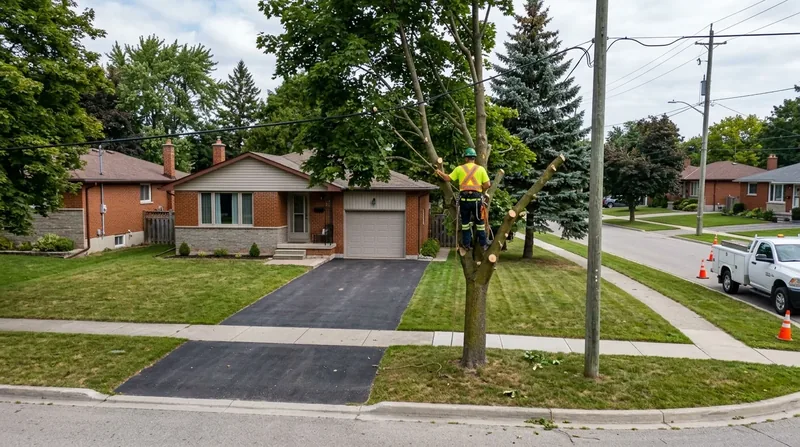




Trees near hydro lines in London require careful, professional clearance to protect your home's electrical service entrance and maintain safety around your property. Mature maples, oaks and birches across the London area often grow dangerously close to the private wire running from the utility pole to your house, creating both a fire hazard and a risk of power loss during storms. Our ISA Certified Arborists understand the specific approach distances that must be maintained, and we work only on the customer's private service entrance, never on the public distribution network operated by your local utility or Hydro One. Since 2012, Forest City Tree Trimming has cleared branches interfering with hydro lines for hundreds of homeowners in London and the surrounding municipalities, combining precision work with full insurance protection and clean-up. Call us at (548) 708-7545 for a free estimate, or learn more about our full range of tree trimming services.
Why clearance near hydro lines is essential in the London area
Branches touching or rubbing against the service entrance wire create multiple dangers: electrical arcing, power interruptions during ice storms or windstorms, and fire risk if the insulation fails. In post-war subdivisions across London, mature trees were often planted without regard for future utility placement, leaving homeowners with overgrown limbs hanging directly over their service lines. Winter ice storms and summer windstorms are particularly common in this region, and heavy snow or wind can snap weakened branches onto live wires. Clearing these branches before a storm arrives protects both your electrical system and your family.
- We identify all branches within the safety zone around your private service entrance.
- We remove or trim branches using certified rigging and climbing techniques to prevent damage to the wire or house.
- We respect the minimum approach distance required by electrical safety standards.
- We document the work and dispose of all wood debris on site or arrange chipping.
- We never work on the public distribution network, which remains the sole responsibility of Hydro One or your local utility.
This preventive work often costs far less than repairing a fire-damaged roof, replacing a service panel after a lightning strike, or restoring power after an ice storm knocks branches across your lines.
Local insight: During the 2013 ice storm, hundreds of London-area homes lost power for days because branches laden with ice collapsed onto service wires. Preventive trimming reduces that risk by up to 80 per cent and is typically completed in a single visit.
How we clear branches safely near your electrical service entrance
Our approach combines visual inspection, precise measurement and certified climbing techniques. We begin by walking your property to locate the service entrance and identify every branch within the critical clearance zone. We then assess branch size, weight, proximity to the wire and structural integrity. Depending on the situation, we may use hand pruning, climbing with rigging lines, or aerial lift equipment to remove or trim branches without disturbing the electrical wire or the house structure. After cutting, we haul debris to the curb or arrange wood chipping through our wood chipping service.
- We perform a full site walk and photograph the service entrance and surrounding trees.
- We measure the distance from each branch to the wire and confirm the required clearance.
- We cut branches using certified techniques, lowering or rigging heavy limbs to avoid the wire.
- We remove all cut material and leave the site clean and safe.
- We provide a written summary of work completed, useful for your insurance or municipal records.
The entire process typically takes 2 to 4 hours for a standard residential lot, depending on tree size, branch density and access. We arrive with all necessary equipment, including climbing gear, rigging lines, chippers and disposal containers.
Real example: A Sunningdale homeowner had a 15-metre silver maple with three major branches within 1 metre of the service wire. We removed those branches in one morning, lowering each limb by rope to prevent any contact with the wire. Cost: from $450 to $650. The work prevented a potential fire hazard and gave the homeowner peace of mind before the winter storm season.
Trimming methods and equipment used in London neighbourhoods
| Method | Description | When we use it |
|---|---|---|
| Hand pruning | Cutting branches up to 5 cm diameter using hand saws and loppers from the ground or a ladder. | Small branches, low heights, tight residential lots common in London. |
| Climbing and rigging | Our arborist climbs the tree using ropes and harness, cutting branches and lowering them safely by rope to avoid the service wire. | Large branches near the wire, tall trees, situations where a branch falling freely would damage the house or line. |
| Aerial lift | A bucket truck positions the operator at branch height, allowing precise cutting and lowering of large limbs. | Very tall trees, multiple large branches, situations where climbing is unsafe or impractical. |
| Crown reduction | Selective removal of outer branches to reduce overall crown size and weight, improving the tree's structure. | Mature trees that have grown too large, or when multiple clearance jobs can be combined into one structural pruning. |
We choose the method based on tree species, branch size, proximity to the wire, and property access. A silver maple or red oak near a service entrance in a ravine lot may require climbing and rigging, while a smaller birch in an open yard may be handled entirely from a ladder.
Permits, approach distances and regulatory context
The City of London may require a permit for tree removal or significant pruning on private property, and an arborist report supports that application if one is needed. Rules and thresholds differ across the municipalities in the London area, so we verify local requirements before starting work. More importantly, approach distances around your private service entrance are set by electrical safety standards: a minimum clearance of 1 metre (3 feet) is required around the wire running from the pole to your house. We respect this distance at all times and never work on the public distribution network operated by Hydro One or your local utility, which is their responsibility alone. Our work is fully insured and documented, providing you with a record for your property file or insurance company if needed.
Once the job is complete, we dispose of all branches and debris according to your preference: removal to the curb for municipal collection, chipping on site, or delivery to a local wood recycler. In most cases, clean-up is included in the job price.
Seasonal timing for hydro line clearance in the London region
The best time to trim branches near hydro lines depends on the tree species and your weather patterns. Structural pruning and branch removal are most safely done during dormancy, from late fall through late winter, when trees have dropped their leaves and the risk of disease or pest entry is lowest. However, if a branch is actively rubbing the wire or poses an immediate hazard, we remove it on an emergency basis year-round. Winter ice storms and summer windstorms peak in this region, so many homeowners choose to have clearance work done before November or June to reduce storm risk.
For routine maintenance, we recommend an inspection every two to three years, particularly if you have fast-growing species like silver maples or Norway spruce near your service entrance. Contact us at (548) 708-7545 to schedule a free estimate or to discuss the best timing for your property. You can also visit our contact page to request a free quote and learn about our current availability.
Prices Trees Near Hydro Lines in London — Indicative pricing
| Service | Price | Details |
|---|---|---|
| Branch clearance, small to medium (up to 8 metres height) | From $275 | Hand pruning and removal of branches near service entrance, includes debris removal |
| Branch clearance, large tree or multiple branches (8 to 15 metres) | From $450 | Climbing, rigging and careful lowering of large limbs to avoid wire contact |
| Branch clearance, very tall or complex (over 15 metres or difficult access) | From $750 | Aerial lift, extensive rigging, or ravine lot access; exact price determined on site |
| Emergency removal (same day or next morning) | From $500 | Storm damage or immediate hazard; available 24/7, additional fee applies |
| Travel and site visit | Included | No charge for travel within London and the surrounding municipalities |
| Free estimate | Complimentary | Call (548) 708-7545 or request online; response within 24 hours |
Indicative prices; free, personalized estimate within 24h at (548) 708-7545.