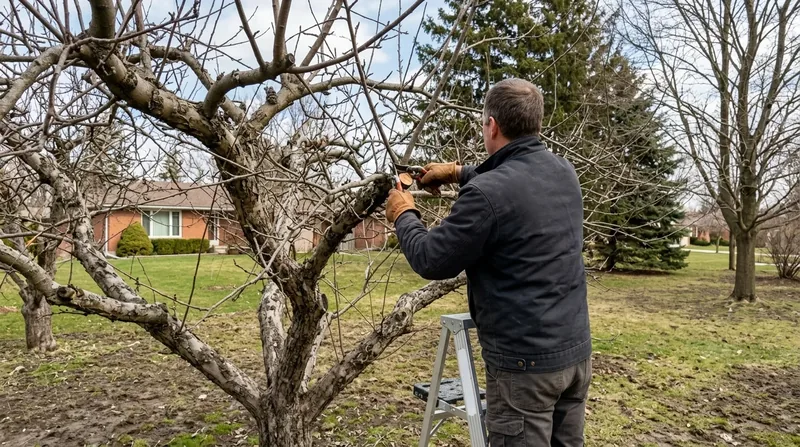




Fruit tree pruning in London restores apple, pear and plum trees to productive health after years of neglect. Many homeowners in the London area inherit or plant fruit trees that have grown wild, tangled or unproductive. Our ISA Certified Arborists open the canopy, remove water sprouts and competing branches, and bring structure back to your garden or small orchard. Whether your trees stopped bearing fruit or have become safety hazards, we prune with the precision that matters for both fruit production and tree longevity. We serve London and the surrounding municipalities with the same care we bring to every tree on your property.
Why fruit tree pruning matters for your London garden
A neglected fruit tree loses its structure and productivity. Crossing branches rub against each other, weak crotches split under snow load, and dense interior growth blocks sunlight and air circulation. Pests and disease settle into dead wood. Fruit production drops because energy flows into weak growth instead of flowering spurs. Pruning redirects that energy and opens the tree to light and air.
In London and the surrounding area, in London and the surrounding area clay soil and freeze-thaw cycles create stress on mature trees. Fruit trees respond well to structural pruning that reduces wind resistance and strengthens branch angles. We remove the dead, diseased and crossing wood that weakens your tree, then thin the canopy to let fruit develop colour and size.
- We remove dead, diseased and broken branches that invite pest and fungal entry.
- We thin crossing and rubbing branches to prevent split crotches and improve air flow.
- We open the centre of the tree to let sunlight reach fruiting spurs.
- We remove water sprouts and suckers that waste tree energy.
- We cut back overgrown limbs to a natural shape and manageable height.
The result is a tree that bears fruit reliably, resists disease, and poses no safety risk to your home or outbuildings.
Key fact: A mature apple or pear tree in Masonville or central London can produce 50 to 100 pounds of fruit per year after proper pruning, compared to little or nothing when crowded and unpruned. One pruning session often restores productivity within a single growing season.
How we prune your fruit trees in the London area
Fruit tree pruning follows a discipline. We do not simply thin randomly. We assess the tree's age, species, current structure and your production goals. Apple and pear trees respond to open-centre or modified central-leader forms. Plum trees prefer a vase shape. We work to that architecture, removing what competes with it and building on what remains.
Our approach respects dormancy. Late fall through late winter is the ideal window for structural pruning in London, when the tree has no active growth and we can see the branch structure clearly. We make clean cuts at branch collars, never flush to the trunk, and never apply wound dressing (trees heal better without it). We remove all brush and debris from your property when the work is complete.
- We assess the tree's form, age and health before cutting anything.
- We remove all dead wood, cutting back to live tissue.
- We remove branches that cross, rub or grow inward towards the centre.
- We thin the canopy to roughly 50 per cent light penetration at the base.
- We cut back overgrown limbs to restore a natural, balanced silhouette.
- We remove all brush and wood chips from your yard.
The entire process respects the tree's natural growth habit and leaves it stronger, not wounded.
Example from the field: A 25-year-old apple tree in Stoneybrook had not borne fruit in eight years. The canopy was so dense that light could not reach the interior. We removed 40 per cent of the branch mass, opened the centre, and cut back competing limbs. The following summer, it produced 60 pounds of apples. The owner pruned it annually after that.
Pruning methods for different fruit tree species
| Species | Pruning form | Key points |
|---|---|---|
| Apple | Open-centre or modified central leader | Remove competing leaders, thin to 45 degree crotches, leave 3 to 4 primary scaffolds. |
| Pear | Modified central leader | Maintain central stem, remove branches at narrow angles, prune less aggressively than apple. |
| Plum | Vase or open-centre | Remove centre stem if crowded, keep 4 to 5 main branches radiating outward, thin interior growth. |
| Cherry | Modified central leader | Prune minimally, avoid large wounds, remove crossing or inward-growing wood only. |
Each species has its own architecture. Apples tolerate aggressive pruning and respond by fruiting heavily. Pears prefer gentler work. Plums and cherries need less intervention. We tailor our cuts to the tree's natural habit and your London property's specific conditions.
Timing and seasonal considerations
Dormancy is the golden window for fruit tree pruning in London. Late fall through late winter, when trees have dropped their leaves and growth has stopped, is the safest time to prune. Cold weather slows disease entry, and you can see the full branch structure without foliage in the way. In spring, once buds break and growth begins, pruning wounds close faster and the tree heals with vigour.
Summer pruning is possible but less ideal. It stresses the tree during active growth and can invite sunscald on exposed limbs. We avoid heavy pruning in summer unless the tree has diseased or hazardous branches that must come down immediately. Light summer thinning to remove crossing limbs or improve air flow is safe and sometimes necessary.
For fruit trees in Middlesex Centre, Strathroy-Caradoc and other surrounding areas, late January through February is often the last safe window before spring growth accelerates. We schedule pruning work to finish before bud break. Contact us at (548) 708-7545 to book your fruit tree pruning during the optimal dormant season and ensure your trees are ready to fruit the following summer.
What happens after pruning
Once we finish, your fruit tree enters a recovery and renewal phase. Energy that was spread across weak, crossing and dead branches now concentrates in the remaining limbs. Buds along cut edges break and grow, creating new fruiting wood. Within two to three growing seasons, the tree typically returns to full production.
We do not apply pruning sealant or wound dressing. Modern arboriculture recognizes that trees compartmentalize wounds naturally and heal faster without wound dressing. We make clean cuts at the branch collar (the swollen ring where a branch meets the trunk) and let the tree do the rest.
All brush, branches and debris are removed from your property. We can chip larger limbs on site if you wish, or haul everything away. Your garden is left clean and ready for the growing season. For a free estimate on fruit tree pruning in London or the surrounding municipalities, contact Forest City Tree Trimming or call (548) 708-7545. We are fully insured, our arborists hold ISA Certification, and we have served the London area since 2012.
If your fruit trees need pruning or you are unsure whether they are healthy, visit our tree pruning page for more detail on structural work, or see our complete service areas to confirm we reach your neighbourhood. We also offer arborist reports if you need a professional assessment before deciding on pruning.
Prices Fruit Tree Pruning in London — Indicative pricing
| Service | Price | Details |
|---|---|---|
| Small fruit tree (under 6 metres) | From $155 | Basic pruning, opening canopy, removal of dead wood and water sprouts |
| Medium fruit tree (6 to 10 metres) | From $275 | Structural pruning, thinning, branch removal, full cleanup |
| Large or neglected tree (over 10 metres or heavily overgrown) | From $425 | Extensive pruning, major branch removal, multi-stage work, full site cleanup |
| Multiple trees (3 or more) | From $650 | Discounted rate per tree, all cleanup included |
| Travel and setup | Included | In London and the surrounding municipalities |
| Free estimate | Free | No obligation, response within 24 hours at (548) 708-7545 |
Indicative prices; free, personalized estimate within 24h at (548) 708-7545.